Justice, Not Recommendation: The Foundation of a Civilized State
As India enters the seventy-ninth year of Independence, it has every reason to take pride in its achievements. We are among the world&rsquos largest democracies and fastest-growing economies. Our progress in science, technology, infrastructure, defence and global diplomacy has earned global recognition. Yet, beneath these achievements lie unresolved questions that continue to test the conscience of the Republic.
Why did thousands of victims of the 1984 anti-Sikh massacres in Delhi and several other States have to wait decades for justice? Why do the painful memories of extra-judicial killings during the years of terrorism in Punjab still leave many families seeking closure? Why do issues that could have been resolved through timely dialogue and statesmanship often grow into prolonged national disputes?
The issues that gave rise to the Dharam Yudh Morcha more than four decades ago continue to evoke debate despite repeated changes of governments in Punjab and at the Centre. Likewise, the Ram Janmabhoomi dispute at Ayodhya took more than five centuries to reach its constitutional resolution. History teaches a simple lesson: unresolved issues do not disappear with time. They deepen, become more emotional and eventually demand a far greater price to resolve.
The relationship between Hindus and Sikhs presents another important example. For centuries they have shared a common civilizational heritage, stood together against oppression and enriched India&rsquos spiritual and cultural life. Yet, from time to time, political interests have sought to create misunderstandings and divisions. Those committed to national unity know that healing old wounds is infinitely harder than exploiting them.
These examples compel us to ask an uncomfortable question: where does the fault lie? Is it in an education system that prepares students for careers but not always for character? Is it in politics, where immediate electoral gains sometimes outweigh long-term national interest? Is it in the bureaucracy, where recommendation occasionally supersedes merit? Is it in policing, where professionalism is sometimes overshadowed by external pressures? Or is it in the judiciary, where justice often arrives after years of delay? Perhaps the challenge lies across all our institutions, united by a gradual erosion of ethical values.
Every civilization ultimately rests upon one invisible pillar&mdashjustice. Wealth creates prosperity, military strength provides security and scientific progress improves human life. Yet only justice creates a civilized nation. Whenever justice is replaced by recommendation (sifarish), influence, favouritism or fear, the moral foundations of society begin to weaken.
Today, recommendation is sought for appointments, promotions, admissions, transfers, contracts, licences, police investigations, registration or cancellation of criminal cases and even routine administrative work. Citizens increasingly seek influential individuals rather than rely upon institutions. This is not merely administrative inefficiency it is moral corruption. Every undeserved favour granted to one individual silently denies justice to another.
Justice is not merely one function of government it is its foremost duty. Development, welfare, security and prosperity all rest upon this foundation. Without justice, democracy gradually loses its moral authority and institutions lose the confidence of the people.
Indian civilization recognised this truth thousands of years ago. The Mahabharata declares, &ldquoDharmo Rakshati Rakshitah&rdquo&mdashDharma protects those who protect Dharma. Justice is the practical expression of Dharma, and when justice weakens, Dharma itself is endangered.
The Bhagavad Gita reminds us: &ldquoWhenever righteousness declines and unrighteousness rises, I manifest Myself.&rdquo The message is timeless. Societies that tolerate injustice ultimately pay a heavy moral, social and political price.
The Sikh Gurus transformed justice into both a spiritual and social obligation. Guru Nanak Dev Ji proclaimed Ik Onkar, the oneness of the Creator, and taught, &ldquoEk Pita Ekas Ke Hum Barik&rdquo&mdashthere is One Father and we are all His children. If humanity shares one Creator, discrimination based on religion, caste, wealth or influence has no moral legitimacy.
Guru Ravidas envisioned Begampura, a city free from fear and oppression. The ideal of Halemi Raj, celebrated in the Guru Granth Sahib, represents governance rooted in humility, compassion and justice. The Indian concept of Ram Rajya similarly envisages a State founded upon righteousness and the welfare of every citizen. Though expressed through different traditions, these ideals converge upon one universal principle&mdashthe purpose of the State is to secure justice without fear or favour.
Guru Tegh Bahadur sacrificed his life to defend the freedom of conscience of others. Guru Gobind Singh declared that when every peaceful means has failed, resistance to tyranny becomes a moral duty. Justice, in Sikh philosophy, was never confined to one community it was universal.
History also offers remarkable examples of rulers remembered not merely for conquest but for justice. Raja Vikramaditya became synonymous with impartial justice. Maharaja Ranjit Singh built perhaps the finest example of inclusive governance in nineteenth-century Asia. Hindus, Muslims, Sikhs and Europeans served according to merit. Mosques, temples and gurdwaras received equal respect. Even the Maharaja subjected himself to moral accountability whenever he believed he had erred.
Kautilya, in the Arthashastra, wrote: &ldquoIn the happiness of his subjects lies the king&rsquos happiness in their welfare his welfare.&rdquo He warned that corruption among public officials destroys a State more effectively than an invading army. Public office, he believed, was a sacred trust.
The same principle echoes across civilizations. Aristotle saw justice as giving each person what is due. Plato viewed justice as the harmony that sustains society. Confucius linked national strength to moral character, while Marcus Aurelius advised rulers: &ldquoIf it is not right, do not do it.&rdquo Across cultures and centuries, the message remains remarkably consistent.
India&rsquos ancient centres of learning, including Takshashila and Nalanda, aimed to produce not only scholars but men and women of character. Modern education has undoubtedly strengthened scientific knowledge and professional competence, but moral and civic education has not received equal attention. The result is visible: we produce capable professionals, yet not always conscientious citizens.
The Constitution of India begins with a promise of Justice&mdashsocial, economic and political. It is no coincidence that justice precedes liberty, equality and fraternity. Without justice, the remaining constitutional ideals cannot endure.
Yet recommendation has gradually become an accepted instrument of governance. Every undeserving appointment deprives a deserving candidate. Every manipulated investigation weakens confidence in the police. Every politically influenced transfer discourages honest officers. Every misuse of authority weakens the rule of law.
The police perform one of the most difficult responsibilities in a democracy. They require operational independence as well as strict accountability. Likewise, the judiciary remains the guardian of constitutional liberties, but justice delayed often becomes justice denied. When litigation continues for decades, many citizens lose not only their cases but also their faith in the system.
The bureaucracy, too, must remain politically neutral while remaining fully accountable to constitutional authority. Frequent transfers, patronage and the pursuit of influential postings weaken administrative independence. The greatest victim is always the ordinary citizen.
The challenge extends beyond government. Religious institutions, educational bodies, professional organisations and voluntary associations must also remain above favouritism. Whenever fairness is sacrificed, moral authority inevitably declines.
India&rsquos greatest challenge today is therefore ethical as much as institutional. Laws may be amended, procedures simplified and technology improved. Yet unless character is strengthened, corruption merely changes its form.
Nation-building is not achieved only through highways, airports, industries or digital infrastructure. It is achieved by producing honest citizens. Schools must teach integrity, universities must reward merit, legislatures must uphold constitutional morality, the executive must govern transparently, the bureaucracy must serve impartially, the police must enforce the law fearlessly and the judiciary must deliver timely justice.
The measure of a nation is not how it treats the powerful, but how it protects its weakest citizen.
India does not need a culture of recommendation. India needs a culture of justice.
When merit replaces influence, corruption will naturally decline. When accountability replaces favouritism, public confidence will return. When justice becomes our highest national value, institutions will regain their credibility.
If India is to become not only a developed nation but also a morally great civilization, we must restore justice to the place where our sages, Gurus, philosophers and the Constitution have always placed it&mdashat the very centre of national life.
Only then will the ideals of Ram Rajya, Halemi Raj and Begampura become living realities. Only then will every Indian believe that justice is secured not through recommendation or influence, but through truth, merit, equality and the rule of law.
A nation is not judged by the wealth of its rulers, but by the certainty of justice available to its weakest citizen.
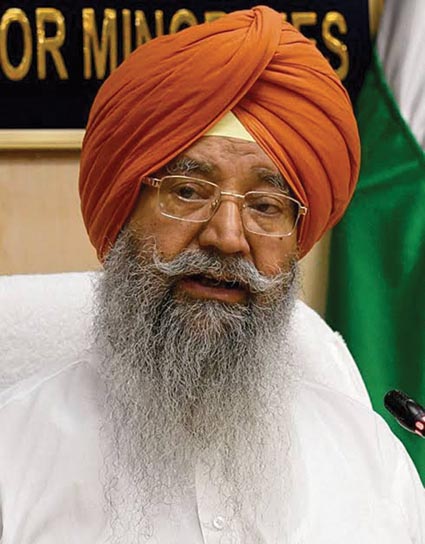
Dr. Iqbal Singh Lalpura
The author is Former Chairman, National Commission for Minorities, Government of India.