Devolution of Sikh Institutions
Sikhi is a global reality, so Panth‑binding legitimacy cannot be demanded through any narrow, territorially bounded pipeline, statutory board, or personality. Legitimacy must be demonstrable through Gurmat process and representation that the global Panth can verify. []]Gurjit Singh Sandhu, Researcher, London.]
A process of devolution of Panthic decision-making from Indian Panjab to the Sikh diaspora, has gathered pace in recent years. More so as the credibility gap between office bearers of Sikh institutions and Sikh diaspora increases. Nanakshahi calendar issue is one example of this process.
Spiritual and temporal Sikh sovereignty is rooted in the Institution of Sri Akal Takht Sahib. The Institution is not fixed to any location or in time or limited by any temporal law. Diaspora Sikhs have never accepted any Indian law or act limiting Sri Akal Takht sovereignty.
By Panthic consensus and historical tradition, the administration of this Institution is located in Darbar Sahib Complex facing Sri Harmandir Sahib. Otherwise, this Source of Panthic miri-piri power resides in the Guru and the Sangat. It is not confined to some building or any one geographical location. The authority of the administrative caretakers (Jathedars) derives from their interpretation and representation of the wishes of the global Panth. If they get it wrong, they lose their authority. Regrettably, that has been the case for some decades.
It can also be argued that the idea of Shromani Gurdwara Parbandhak Committee (SGPC) as the mini Parliament of the Sikhs has now lapsed due to non-representation of millions of Sikhs living outside Panjab and abroad. Even in Panjab, there are no regular elections to the SGPC.
Successive Jathedars, as representatives of the global Sikh nation, have witnessed the Sikh religious, language, cultural, economic and political decline since the partition of the Indian subcontinent and later truncation of Panjab, no longer the Land of Five Rivers. Thousands of Sikh youth have lost their lives due to extra-judicial killings by mostly Sikh officers. The Jathedars have lacked Sikhi courage and spirit of sacrifice, discerning intellect and global level qualities to deserve global Panthic respect.
Sikh migration to other countries which started over 150 years ago, has increased in recent decades, especially since the prolonged Third Ghalughara which started in June 1984. More recent political and economic migrants have brought their own grievances against successive Indian administrations while remaining sympathetic to the plight of Indian people including Indian minorities. Sikh activism abroad has increased in line with their numbers.
Most probably, there are now over 3 to 4 million Sikhs living outside India. They have done well as net contributors to the economies of the countries they live in and despite the negative impression promoted by Indian media, Sikhs are regarded as hardworking and law-abiding loyal citizens. As was to be expected, due to their increasing numbers, post 1984 arrivals have gained management control of most Gurdwaras and resources.
To sum up, Sikhi is now a global reality while our, hitherto central institutions in Panjab, seem to have become more introvert and lost their position as guardians of Sikh national interests. In diaspora countries, back-to-basics Sikhi research, unpolluted by Brahmanic influence, and charity work outside Gurdwaras, is thriving. Discipline at Nagar Kirtans and even lawful protests has been praised by the police. Sikhi way of life is better understood and mistaken identity challenge is being overcome.
A quiet devolution of Sikhi, guided by Sri Guru Granth Sahib and collective Panthic Will determined by modern global communications, has been taking place.
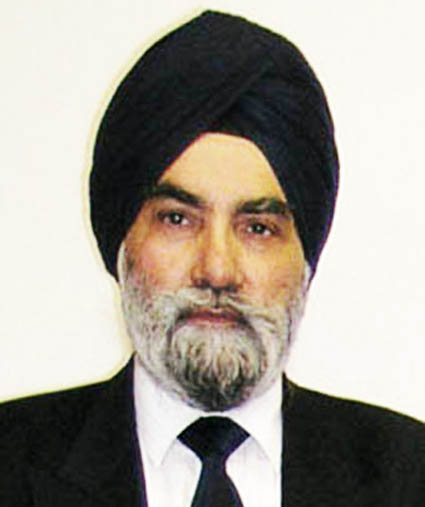
Gurmukh Singh OBE
E-mail: sewauk2005@yahoo.co.uk
https://www.sikhiwiki.org/index.php/Gurmukh_Singh_OBE