Sikh Diaspora Renaissance: Religious Cultural and Political Revival
Renaissance refers to cultural, political and scientific revival in 14 to 16 centuries Europe. Generally, it refers to any such revival over a period of time. In case of the global Sikhs today it means the re-discovery of true Sikhi following the politicisation and weakening of central Sikh institutions in Panjab.
To digress slightly: In was towards the end of 20th century that late Bhai Rama Singh Ji of Akhand Kirtani Jatha, UK, predicted that one day Sikhs from abroad will preach true Sikhi in Panjab! His autobiography was published in Panjabi by the Panjab Times UK as Roop Gobind ka, Raj Khalsay Ka, Sikka Sonay Ka, through the efforts of a Gursikh couple, Bhai Sukhdev Singh and Bibi Amarjit Kaur of Southall. Later, Bhai Sahib and some Gursikhs led by late S. Kesar Singh Mand, persuaded me to translate the 400 pages volume to English. I completed this sewa towards end 2000 with the new title, In Search of The True Guru (*see link to the e-book). Indeed, Bhai Rama Singh did search for The True Guru and found Him. Just as we are searching for true sovereign Miri-Piri Sikhi of the Guru today!
To quote a source: The future of Sikh central institutions in India, primarily the Shiromani Gurdwara Parbandhak Committee (SGPC) and the Akal Takht, is currently at a critical juncture, facing challenges related to political autonomy, internal cohesion, and the need to adapt to modern, globalized challenges. While these institutions remain central to Sikh religious life, their long-term viability is tied to their ability to adapt to changing socio-political dynamics, including a rise in independent, local-Sangat-driven, and, in some perspectives, diaspora-influenced leadership.
This is also the time when next generation young Sikhs in the diaspora are exploring true Sikhi roots in Gurbani, classical Sikh literature and music, and Guru Khalsa It-haas (history), art and Gurbani Shabad.
Young diaspora Sikhs are in the process of reclaiming their true ideology, institutions and identity. This process of re-discovery is gaining momentum rapidly through global social media. As one example, there are discourses by those like Dr Jvala Singh of California. He also net-works closely with UK-based organizations like the United Kingdom Punjabi Heritage Association (UKPHA).
He interprets literature associated with Guru Gobind Singh Ji, in a most constructive and non-controversial way from a Sikhi viewpoint. The Sikhi dimension is introduced so that Khalsa socio-political objectives are set at a much higher level than those of the heroes of the Vedas or Katebas. The fresh Sikhi paradigm thus introduced, eliminates controversy.
We are reminded that on December 21, 1704, during the crossing of the flooded Sirsa River, despite earlier promises, there was a treacherous surprise attack by the combined Mughal and Pahari Rajas. Immense losses included the vast library of literature at Anandpur collated over many years.
There is also revival of keen interest in Sikh classical music and art. Historical Sikh artefacts are collected and exhibited. Major international institutions are increasingly hosting Sikh-focused galleries. Notable examples include the Kapany Collection at the Montreal Museum of Fine Arts and exhibitions at the Asian Art Museum in San Francisco. Sikh Museum Initiative in UK uses 3D ling and augmented reality to digitally preserve Sikh artifacts and weaponry for the global audiences.
Art images of Sikh historical struggles for survival revive global interest in Sikhs as a distinct people. Naturally, that also stimulates Sikh political consciousness as a people, the global Sikh nation.
* https://www.sikhmissionarysociety.org/sms/smspublications/Autobiography-Bhai-Rama-Singh-Ji.pdf
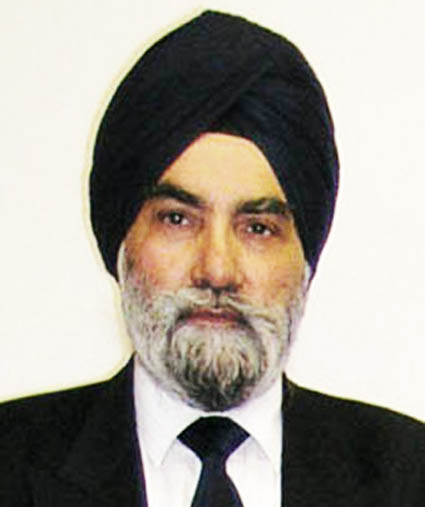
Gurmukh Singh OBE
E-mail: sewauk2005@yahoo.co.uk
https://www.sikhiwiki.org/index.php/Gurmukh_Singh_OBE